



Formative and summative assessment, the two main types of assessing knowledge and skills, are often confused with one another. Both types of assessment have a place in the teaching and learning process, but it can be difficult to distinguish between formative and summative assessment.
Both formative and summative assessments are used to assess learning, provide feedback to students and collect information for the purposes of future planning. Therefore, it is important to understand the differences and their purposes in education and training.
Assessment is defined as the process of collecting, analysing and evaluating information about a student for educational purposes.
Assessment involves gathering evidence to understand where a student is in their learning journey and what they know and don’t know, as well as how to improve the quality of what the student is learning.
When planning a lesson or teaching session, what kind of assessment strategy, formative or summative, should you use?
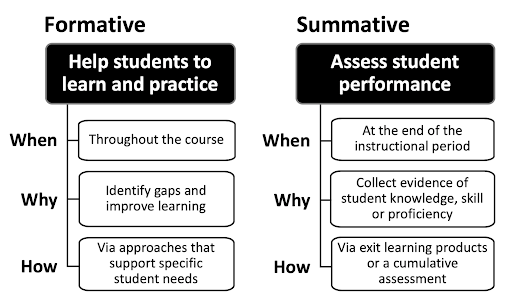
Formative assessment (FA) is ongoing during the learning process, and provides feedback for improving instruction.
Summative assessment (SA) is characterised as a one-time event used to make a judgment or decision about a student’s knowledge or skills.
The main difference between these two types of assessments lies in how the information is used by the trainers/assessors.
Formative assessments, also known as formative evaluation (FE) , occur while the student is studying. Formative assessment measures the student’s progress throughout the learning process and provides immediate feedback to help the student improve skills. These assessments give trainers and assessors feedback on how well the students understand what they have been taught so far, and is an ongoing process throughout a teaching session or unit of study. The goal of formative assessment is to identify what each learner knows and does not know so that teaching can be customised accordingly. Some examples of formative assessments are quizzes, observations, homework, classwork, exit surveys, discussions in class, turning in research for early feedback, classroom polls, creating diagrams and charts such as Venn diagrams, T/charts and so on. The purpose of formative assessments is usually to improve student’s learning. The formative assessments consider evaluation as a process.
A summative assessment is the end assessment, meaning it occurs at the very end of a course or curriculum unit. It measures everything that the student has learned throughout the study period – not just one lesson – and also shows how much they have improved or mastered specific skills. A summative assessment results is a grade or other evaluation that determines the placement, advancement or competency of a student. This type of assessment generally does not provide feedback for improvement; rather, it is an endpoint from which to decide where the student stands with regards to meeting objectives set by the assessor. A summative assessment is usually based on certain standards and criteria that evaluates the student’s learning related to a training product. Some examples of summative assessments include end of unit/term assessments, end of unit portfolios, standards-based assessments, final projects or papers and so on. The purpose of summative assessments is usually to evaluate the student’s achievements and performance. The summative assessments consider evaluation processes as an end product.
The main difference between formative and summative assessments:

In addition, there is a significant difference between the assessment strategies in terms of obtaining reliable information about the student’s learning.
Formative assessments are used to determine if a student requires additional assistance by closely monitoring the learning process.
Summative assessments offer competency to students. It tells you whether a student has met the learning objectives based on performance.
The purpose of the assessment process
During the formative assessment, the goal is to help students enhance their overall learning. It is necessary to be able to provide meaningful feedback in order to do this.
In formative assessment, the evaluation takes place numerous times throughout the learning process, whereas with summative assessment, the evaluation takes place at the conclusion of a unit of competency or course. This also explains why the assessments may have different size and duration of completion.
The formative assessment covers only a small number of curriculum areas. For instance, a small set of questions based on one element from a unit of competency.
In summative assessment, the goal is to determine how well a student has done academically.
Decide whether or not you want your students to be the best at something, or whether you want them to transcend themselves each and every time they take part in it.
The summative evaluation comprises the evaluation of entire chapters or content areas in a unit of competency. For example, at the end of a unit of competency, there may only be one evaluation. Therefore there will be a number of assessments included when students are doing their summative assessments.
Formative vs Summative Assessment: A Comparison






Interview with Wendy Perry – Managing Director, Workforce BluePrint
BIO: Wendy Perry Managing Director Workforce BluePrint Wendy Perry who…