A recent figures revealed that the federal government over the last five years has underspent close to $1 billion of its budget on TAFE, training and apprenticeships. This is on top of previous cuts.
At the same time, that these budgets cuts are happening, Australia is still experiencing critical skills shortages in several industries. A number of experts have warned of serious effects on the Australian economy.
The report released by the Australian Industry Group can be found here: www.aigroup.com.au
It also identified:
- Skills shortages: 75 percent of respondents reported skills shortages in industry, a jump from 49 percent in the previous survey conducted in 2016. Shortages are most often in the technician and trades worker category, with difficulties recruiting for Science, technology, engineering, and mathematics (STEM) skills, and new shortages for roles in business automation, Big Data and artificial intelligence solutions.
- Literacy and Numeracy: 99 percent of employers (up from 96 per cent in 2016) are affected in some way by low levels of literacy and numeracy in their workforce. This is disturbing in a time when the workforce increasingly requires foundation skills that include not only literacy and numeracy but digital literacy and advanced soft skills.
- Leadership and Management: employers are prioritising technology capability improvements for managers, 62 percent of whom believe a lack of leadership and management skills is having a high impact on the business (up from 56 percent in 2016). This reflects the major changes needed in the way work is done and managed as entire business processes and organisational cultures are upended in the digital economy.
At the time of its 2018 survey, Ai Group called for new approaches to education, training and re-skilling to maximise the benefits of the digital economy.
“Our survey has found major skills demand issues facing employers,” chief executive Innes Willox said.
“It provides an important gauge of employer sentiment around skill needs, education and training at a critical time for industry transformation.”
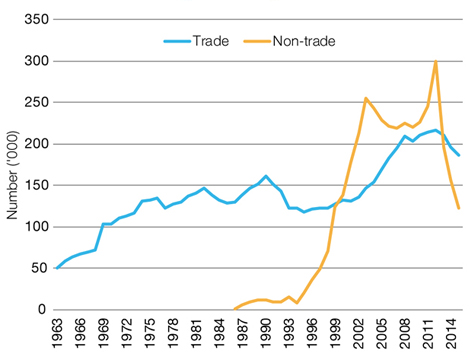
Image Source: NCVER, Apprentices and trainees 2015 December quarter

The number of Australians completing an apprenticeship or traineeship is lower today than it was a decade ago.
Let’s look at the apprentices and trainees data now over the last few years.
Since 2013, according to data compiled by the National Centre for Vocational Education Research (NCVER), apprentice numbers have dropped by 25 to 50 percent.
The number of apprentices and trainees who commenced training in September 2013 dropped by 49.56 per cent from 71,600 to 36,115 by September 2017.
The number of apprentices and trainees who were in training during this same period dropped by 34.7 percent from 413,300 to 269,905.
Apprentice and trainee completion rates from September 2013 also dropped from 35,900 by 35.86 per cent to 23,025 by September 2017.
The figures from NCVER to the end of December 2018 show the number of apprentices and trainees who commenced training dropped from 71,600 in September 2013 to 33,760 in December 2018, representing a 52.85 per cent fall.
The number of apprentices and trainees in-training dropped from 413,300 in September 2013 to 259,385 in December 2018, resulting in a 37.24 per cent reduction during the time period.
The number of apprentices and trainees who completed their training in September 2013 dropped from 35,900 to 26,780 in December 2018.
What are the reasons for this fall in numbers? Some of the factors are:
- Government policies reducing the subsidised training courses offerings
- Focusing on public education and training organisations and neglecting the private education providers
- Too many expectations from employers and not enough rewards,
- No effective education and training reforms No or less engagement of group training organisations
- Too much bureaucracy and paperwork
- Ineffective In-School VET programs
- Few Multi-Industry Pre-Apprenticeship programs
- A regulator that does not understand the changing needs of the time and learners or
- A mix of all these factors?
We believe the more investment in the public and private training and education organisations and policy and regulatory changes are the only ways to move forward.